

Fine Art Collecting
Collecting Watercolour Seascapes: What to Look For
A practical guide to evaluating watercolour paintings, understanding paper quality, and building a meaningful collection.
Why Watercolour Seascapes Matter
Watercolour seascapes aren't just pretty pictures. They're about capturing light on water, the movement of waves, and the feeling of standing at the shoreline. There's something magical about how water behaves in watercolour — it flows naturally, bleeds into adjacent colours, and creates effects that're nearly impossible to replicate in other mediums.
Whether you're starting your first collection or adding to an established one, knowing what separates a compelling seascape from an ordinary beach painting matters. It's the difference between a piece that'll hold your attention for years and one you'll eventually forget hanging on your wall.


Understanding Paper Quality
Paper is where everything starts. You can't have a quality watercolour on cheap paper — it just doesn't work. Look for papers with at least 140gsm weight. Anything lighter buckles under water application. Most serious artists use 300gsm or higher.
Cotton rag papers like Saunders Waterford or Arches hold water beautifully and allow colours to lift back off without damage. They've got tooth that grabs pigment, creating depth. Wood pulp papers yellow and deteriorate over time — they're fine for sketches, not for investment pieces you're buying to keep forever.
Check the painting's reverse side if you can. You'll see the watermark of the paper mill. That single detail tells you everything about the artist's commitment to their craft.
Recognizing Technical Skill
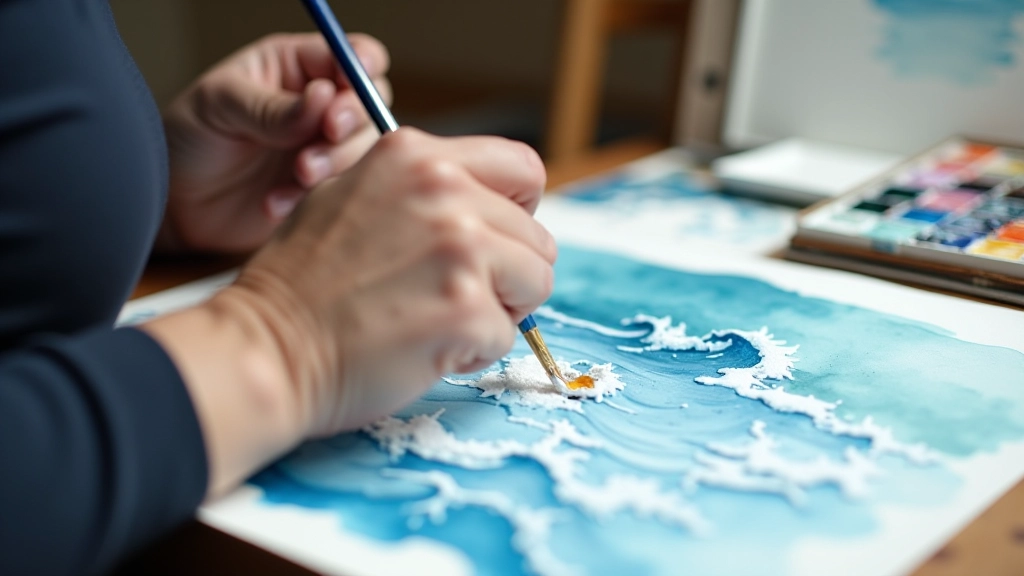
The hallmark of excellent watercolour isn't perfect detail — it's restraint. The best seascapes suggest waves rather than rendering every ripple. They know where to leave white paper showing (your brightest lights), where to drop in glazes, and when to stop.
Watch for these technical markers: Luminosity comes from transparency and layering, not from adding white paint. Good seascapes have aerial perspective — distant water feels further away because it's lighter and hazier. Edges vary — some sharp (foreground rocks), some soft (distant shoreline). This variation creates depth and interest.
Look at how the artist handles water movement. Does the ocean feel like it's actually moving? Are there convincing reflections? The best pieces show understanding of light physics — how reflections sit directly below light sources, how shadows have colour (never pure black).
Composition That Holds Your Eye
Strong compositions follow certain principles, though the best artists bend them. The rule of thirds works — placing the horizon line in the upper or lower third rather than dead centre. But what really matters is whether the painting keeps you looking.
Does the eye travel through the piece naturally? A good seascape might lead you from foreground rocks, across water, to a distant sailboat, then to sky. There's a journey. Weak pieces feel flat and static — everything's equally important or unimportant.
Consider value range too. The best seascapes use the full spectrum from near-black shadows to pure white highlights. Limited value ranges feel weak and washed out. You want contrast that creates drama and draws attention.
Colour Harmony and Authenticity
Water isn't blue. That's the first lesson. Real seascapes show water in greens, purples, greys, and even warm tones depending on sky conditions and light. Artists who understand this create convincing pieces. Look for subtle colour relationships — how blues relate to the surrounding colours, how warm and cool tones balance each other.
Quality watercolours use real pigments mixed on the paper, not premixed commercial colours straight from the tube. You'll see more complexity, more life. The water will shimmer. Skies will feel atmospheric rather than flat and solid.
Check if colours feel natural to you. Does the painting evoke the actual experience of being by the sea? Or does it feel artificial? Your gut reaction matters — it's telling you whether the artist truly understood the subject.

Practical Evaluation Checklist
Paper Foundation
Is the paper at least 140gsm? Does the watermark suggest a quality cotton rag paper? Check the back for any stains or damage that suggests poor preservation.
Light and Luminosity
Can you see where light originates? Are highlights created by transparent layers or white paint? Does the painting glow from within or sit flat on the surface?
Edge Variation
Do edges change throughout — some soft, some hard? Varied edges create visual interest and suggest depth. Uniform edges feel amateur and stiff.
Water Movement
Does the ocean feel alive? Can you sense wave direction and water physics? Or does it look like a static blue wash with white lines?
Colour Intelligence
Are colours complex and mixed on paper? Do you see reflected light in shadows? Or are colours muddy and overmixed into grey?
Personal Response
Does it move you? Could you live with this piece for years? If you're not drawn to it after careful study, it's probably not right for your collection.
Building Your Collection With Intention
The best collections aren't about owning the most pieces. They're about living with paintings that speak to you, that you notice something new in each time you pass them on the wall. A single exceptional watercolour seascape is worth more than a dozen mediocre ones.
Start by visiting galleries and artist studios. Spend time with pieces. Ask questions about technique, materials, and the artist's process. Collectors who understand the work behind the painting develop a deeper appreciation and make smarter acquisitions.
Trust your instincts but educate them first. Know what you're looking for. Understand the markers of quality. Then, when you find a piece that combines technical excellence with emotional resonance, you'll recognize it.
Ready to explore seascape paintings in person? Visit local galleries in Portugal or connect with established artists who specialize in coastal themes. The experience of viewing watercolours directly changes everything.
Explore Artist PortfolioRelated Articles


Important Note
This article provides educational guidance for evaluating watercolour seascapes and building an art collection. The suggestions and evaluation criteria reflect general principles of watercolour painting and art collecting. Individual preferences, artistic styles, and collection goals vary widely. Consider consulting with art experts, galleries, or established artists when making significant art purchases. Market value, provenance, and condition assessments may require professional evaluation by certified appraisers or art specialists.